Introduction
Anomaly Detection
Anomaly Detection(AD)은 여러 분야에서 다양하게 사용됩니다. 보안에서는 외부 침입 감지에 사용될 수 있고 의료에서는 정상과 환자를 구분하는데 사용될 수 있습니다. 오늘 소개할 논문은 제조 분야에서 사용되는 이미지 기반의 AD기법에서 가장 대표 모델인 PatchCore를 소개하겠습니다. 해당 논문은 2022년에 출판되었으며 오랜시간 이미지 기반의 AD 연구에서 비교모델로 사용되고 있으며 대표적인 모델이라고 볼 수 있습니다.
산업 분야에서 2D 이미지 기반의 AD는 제품 외관에있는 결함을 탐지하는데 주로 사용됩니다. 일반적으로 computer vision에서는 classification과 segmentation 모델로 제품의 양/불량을 판단하고 결함 부위를 감지할 수 있지만 두 모델은 지도학습(supervised learning) 방식이기 때문에 라벨링이 반드시 필요합니다. Deep Learning 기반의 지도학습 모델은 학습 데이터가 적어도 1000개 이상이 있어야지 믿을 만한 성능의 모델을 구축할 수 있습니다. 하지만 실제 산업에서는 불량 제품이 많이 생산되지 않기 때문에 데이터를 다량으로 수집하는데 오랜시간이 소요됩니다. 반면에 양품 데이터는 쉽게 얻을 수 있으며 이처럼 불량을 감지하고 싶으나 불량 데이터가 희소한 경우에 AD 기법이 사용 될 수 있습니다.
PatchCore
PatchCore는 대표적인 AD 모델 중에 하나로, 메모리 뱅크 기반으로 이상탐지를 수행합니다. 메모리 뱅크 방식은 embedding-based methods에 속하며, 이외에도 reconstruction-based methods와 synthesis-based methods가 있습니다. PatchCore는 PaDiM을 보완한 모델이며 PaDiM보다 계산 속도가 빠르고 개별 패치를 사용하는 PaDiM과 달리 주변 패치 정보까지 활용하여 이상 탐지 능력을 더 향상시킨 모델입니다. PaDiM에 대한 설명은 지금은 생략하겠습니다.
PatchCore의 전체 프로세스는 아래 그림과 같습니다.
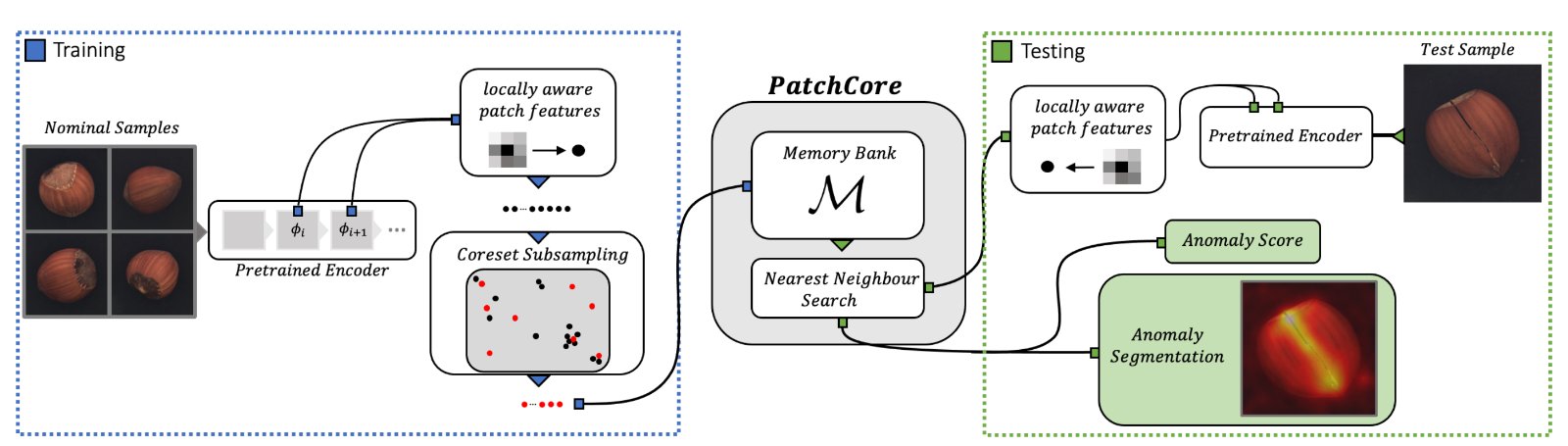
Training
1. Pretrained Encodr
정상 샘플 이미지 데이터를(Normal samples) Wide-ResNet과 같은 CNN기반 모델에 대입하여 특징을 추출합니다.
- 특징을 추출하는데 사용되는 layer는 모델의 마지막 부분이 아니라 모델의 중반 정도의 layer를 사용합니다.
- 모델의 후반부에 있는 layer에서 특징을 추출하면 모델이 기존에 학습된 데이터셋에 영향을 많이 받게되어 우리가 특징을 추출하고자 하는 이미지의 특성이 아니라 기존 학습 데이터셋의 특징이 같이 반영될 수 있기 때문입니다.
- 반면에 초반부에 있는 layer를 사용하는 경우, 모델 학습이 미숙하여 이미지에 있는 특징을 제대로 추출할 수 없습니다.
코드 보기
"""wide_resnet101_2 encoder를 이용해 이미지 feature를 추출하는 스크립트."""
import argparse
from pathlib import Path

import cv2
import numpy as np
import pandas as pd
import torch
import torch.nn as nn
from tqdm import tqdm
from torchvision.models import Wide_ResNet101_2_Weights, wide_resnet101_2


class WideResNetFeatureExtractor(nn.Module):
    """wide_resnet101_2를 stem/layer1~4 5구간으로 나눠 각 구간의 출력을 반환."""

    def __init__(self, backbone: nn.Module):
        super().__init__()
        self.stem = nn.Sequential(backbone.conv1, backbone.bn1, backbone.relu, backbone.maxpool)
        self.layer1 = backbone.layer1
        self.layer2 = backbone.layer2
        self.layer3 = backbone.layer3
        self.layer4 = backbone.layer4

    def forward(self, x: torch.Tensor) -> list[torch.Tensor]:
        """5구간(stem, layer1, layer2, layer3, layer4)의 출력 feature map을 순서대로 반환."""
        outputs = []
        x = self.stem(x)
        outputs.append(x)
        x = self.layer1(x)
        outputs.append(x)
        x = self.layer2(x)
        outputs.append(x)
        x = self.layer3(x)
        outputs.append(x)
        x = self.layer4(x)
        outputs.append(x)
        return outputs


def build_wide_resnet_encoder(
    pretrained_weights_path: str | None = None,
    imagenet_pretrained: bool = True,
) -> WideResNetFeatureExtractor:
    """
    wide_resnet101_2 image encoder를 생성.

    Args:
        pretrained_weights_path: 로컬 checkpoint(.pt) 경로. 지정하면 torchvision의
                                  ImageNet weight 대신 이 checkpoint를 로드한다.
        imagenet_pretrained: pretrained_weights_path가 None일 때 torchvision의
                              ImageNet 사전학습 weight를 사용할지 여부.
                              False면 random 초기화 weight 사용 (구조 테스트용).
    """
    weights = Wide_ResNet101_2_Weights.IMAGENET1K_V2 if imagenet_pretrained else None
    backbone = wide_resnet101_2(weights=None if pretrained_weights_path is not None else weights)

    if pretrained_weights_path is not None:
        with open(pretrained_weights_path, "rb") as f:
            ckpt = torch.load(f, map_location="cpu")
        if "model" in ckpt and isinstance(ckpt["model"], dict):
            ckpt = ckpt["model"]
        if "state_dict" in ckpt and isinstance(ckpt["state_dict"], dict):
            ckpt = ckpt["state_dict"]

        missing, unexpected = backbone.load_state_dict(ckpt, strict=False)
        print(f"로드 완료. missing keys: {len(missing)}개, unexpected keys: {len(unexpected)}개")

    encoder = WideResNetFeatureExtractor(backbone)
    encoder.eval()
    return encoder


def preprocess_image_array(image_bgr: np.ndarray, img_size: int = 640) -> torch.Tensor:
    """BGR 이미지 배열을 wide_resnet101_2 입력 형식으로 전처리."""
    img_rgb = cv2.cvtColor(image_bgr, cv2.COLOR_BGR2RGB)
    img_rgb = cv2.resize(img_rgb, (img_size, img_size), interpolation=cv2.INTER_LINEAR)
    img_np = img_rgb.astype(np.float32) / 255.0  # 0~255 -> 0~1 정규화

    # ImageNet 표준 mean/std로 정규화 (wide_resnet101_2가 ImageNet으로 사전학습됨)
    mean = np.array([0.485, 0.456, 0.406])
    std = np.array([0.229, 0.224, 0.225])
    img_np = (img_np - mean) / std

    # (H, W, C) -> (C, H, W) -> (1, C, H, W)
    img_tensor = torch.from_numpy(img_np).permute(2, 0, 1).unsqueeze(0).float()
    return img_tensor


if __name__ == "__main__":
  img_size=520
  encoder = build_wide_resnet_encoder(
      pretrained_weights_path=args.pretrained_weights_path,
      imagenet_pretrained=not args.no_imagenet_pretrained,
  )

  total_params = sum(p.numel() for p in encoder.parameters())
  print(f"wide_resnet101_2 encoder 전체 파라미터 수: {total_params:,}")

  output_dir = Path(output_dir)
  output_dir.mkdir(parents=True, exist_ok=True)

  print(f"[대상] {len(img_paths)}개 이미지")
  print(f"[설정] img_size={img_size}, layer={layer}")

  for img_path in tqdm(img_paths, desc="wide_resnet101_2 feature 추출", unit="img"):
      image_bgr = cv2.imread(image_path)
      input_tensor = preprocess_image_array(image_bgr, img_size=img_size)

      with torch.no_grad():
          features = encoder(input_tensor)

      if not (1 <= layer <= len(features)):
          raise ValueError(f"layer={layer}는 유효 범위(1~{len(features)})를 벗어났습니다.")

      feat = features[layer - 1].numpy()
      save_path = output_dir / f"{img_path.stem}.npy"
      np.save(save_path, feat)

  print(f"[완료] {len(img_paths)}개 feature -> {output_dir}")
2.Locally aware patch features
추출된 특징 패치를 이웃 패치와 결합(aggregation)하여 하나의 patch로 사용합니다.
- 논문에서는 Adaptive_average_pool2d을 사용하여 주변 패치의 정보를 결합합니다.
- 1개 layer에서 추출된 feature 만을 aggregation하는 방식과 2개 layer에서 추출된 feature를 aggregation하는 Multi-Hierarchy 방식이 있습니다.
- Multi-Hierarchy Aggregation 은 두 layer에서 추출된 feature를 각각 aggregation하여 feature shape를 맞춰준 뒤에 concat를 수행하고 다시 aggregation하여 target dim 형태로 만들어줍니다.
- 해당 연구에서는 단일 layer보다 Multi-layer를 사용한 경우가 성능이 더 좋다고합니다.
- 중간 레벨의 layer와 후반 레벨의 layer를 혼합한 경우에 좀 더 풍부한 feature 정보를 얻을 수 있기 때문입니다.
코드 보기
"""PatchCore의 locally aware patch feature 및 multi-hierarchy aggregation 모듈."""
import argparse
import json
from pathlib import Path

import numpy as np
import torch
import torch.nn.functional as F


class LocalNeighborhoodAggregation(torch.nn.Module):
    """단일 feature map에 대한 locally aware patch feature 생성.

    Args:
        patchsize: 이웃 크기 p (논문 기본값 3)
        stride: 위치 샘플링 stride (논문 기본값 1)
        output_dim: 목표 feature 차원 d. None이면 입력 채널 수 C를 그대로 사용.
    """

    def __init__(self, patchsize: int = 3, stride: int = 1, output_dim: int | None = None):
        super().__init__()
        self.patchsize = patchsize
        self.stride = stride
        self.output_dim = output_dim

    def forward(self, features: torch.Tensor) -> torch.Tensor:
        """
        Args:
            features: [B, C, H, W] backbone feature map
        Returns:
            [B, d, H', W']  (stride=1이면 H'=H, W'=W)
        """
        B, C, H, W = features.shape
        p = self.patchsize
        d = self.output_dim or C

        # 1) p x p 이웃 추출: [B, C*p*p, L], L = H' * W'
        padding = (p - 1) // 2
        unfolded = F.unfold(features, kernel_size=p, stride=self.stride, padding=padding)
        H_out = (H + 2 * padding - p) // self.stride + 1
        W_out = (W + 2 * padding - p) // self.stride + 1
        L = unfolded.shape[-1] #(batch, 한 patch의 feature 길이, 총 patch 개수), [B, C*p*p, L]

        # 2) [B, C*p*p, L] -> permute:[B, L, C*p*p] -> reshape:[B*L, 1, C*p*p]
        # 메소드 체이닝 : 함수를 . 으로 연달아서 사용하는 방식
        unfolded = unfolded.permute(0, 2, 1).reshape(B * L, 1, C * p * p)

        # 3) adaptive avg pooling으로 d차원으로 압축: [B*L, d],
        # input (N,C,L) : 샘플 개수, 채널, 길이
        aggregated = F.adaptive_avg_pool1d(unfolded, d).squeeze(1)

        # 4) feature map 형태로 복원: [B, d, H', W']
        return aggregated.reshape(B, H_out, W_out, d).permute(0, 3, 1, 2)


class MultiHierarchyAggregation(torch.nn.Module):
    """두 hierarchy의 feature를 PatchCore 방식으로 결합.

    각 레벨에 이웃 aggregation 적용 -> 깊은 레벨을 얕은 레벨 해상도로 bilinear upsample
    -> 채널 concat -> 다시 adaptive pooling으로 최종 차원 d로 통합.
    """

    def __init__(self, patchsize: int = 3, per_level_dim: int = 1024, target_dim: int = 1024):
        super().__init__()
        self.agg = LocalNeighborhoodAggregation(patchsize=patchsize, stride=1,
                                                output_dim=per_level_dim)
        self.target_dim = target_dim

    def forward(self, feat_low: torch.Tensor, feat_high: torch.Tensor) -> torch.Tensor:
        """
        Args:
            feat_low:  얕은 레벨 [B, C1, H1, W1]  (고해상도)
            feat_high: 깊은 레벨 [B, C2, H2, W2]  (저해상도)
        Returns:
            [B, target_dim, H1, W1]
        """
        f1 = self.agg(feat_low)                          # [B, d1, H1, W1]
        f2 = self.agg(feat_high)                         # [B, d1, H2, W2]
        f2 = F.interpolate(f2, size=f1.shape[-2:],
                           mode="bilinear", align_corners=False)

        combined = torch.cat([f1, f2], dim=1)            # [B, 2*d1, H1, W1]

        # 최종 통합 pooling (공식 구현의 Aggregator에 해당)
        B, C, H, W = combined.shape
        combined = combined.permute(0, 2, 3, 1).reshape(B * H * W, 1, C)
        combined = F.adaptive_avg_pool1d(combined, self.target_dim).squeeze(1)
        return combined.reshape(B, H, W, self.target_dim).permute(0, 3, 1, 2)


def _load_feature(path: Path) -> torch.Tensor:
    array = np.load(path)
    return torch.from_numpy(array).float()


def run_aggregation(input_dir: str, output_dir: str, input_dir2: str | None = None,
                     use_hierarchy: bool = False, patchsize: int = 3,
                     output_dim: int | None = None, per_level_dim: int | None = None,
                     target_dim: int | None = None) -> Path:
    """input_dir의 .npy feature들에 aggregation을 적용해 output_dir에 저장.

    - use_hierarchy=False (default): 각 파일에 LocalNeighborhoodAggregation만 적용
      (예: SAM3 layer15).
    - use_hierarchy=True: input_dir2(다른 hierarchy 레벨, 동일 파일명 필요)가 반드시 있어야 하며,
      위 결과에 더해 두 레벨을 결합하는 MultiHierarchyAggregation을 추가로 수행한다.

    두 경우 모두 처리한 모든 샘플의 input/output shape 메타 정보를 output_dir 아래
    단일 JSON 파일(aggregation_metadata.json)로 저장한다.
    """
    if use_hierarchy and not input_dir2:
        raise ValueError("--hierarchy를 사용하려면 --input2가 필요합니다.")

    input_path = Path(input_dir)
    input_path2 = Path(input_dir2) if input_dir2 else None
    output_path = Path(output_dir)
    output_path.mkdir(parents=True, exist_ok=True)

    local_agg = LocalNeighborhoodAggregation(patchsize=patchsize, output_dim=output_dim)
    multi_agg = None
    if use_hierarchy:
        sample_files = sorted(input_path.glob("*.npy"))
        if not sample_files:
            raise FileNotFoundError(f"{input_path}에 .npy 파일이 없습니다.")
        primary_channels = _load_feature(sample_files[0]).shape[1]
        resolved_per_level_dim = per_level_dim or primary_channels
        resolved_target_dim = target_dim or resolved_per_level_dim
        multi_agg = MultiHierarchyAggregation(patchsize=patchsize,
                                              per_level_dim=resolved_per_level_dim,
                                              target_dim=resolved_target_dim)

    metadata = {
        "config": {
            "mode": "multi_hierarchy" if use_hierarchy else "local_neighborhood",
            "input_dir": str(input_path),
            "input_dir2": str(input_path2) if input_path2 else None,
            "output_dir": str(output_path),
            "patchsize": patchsize,
            "output_dim": output_dim,
            "per_level_dim": multi_agg.agg.output_dim if multi_agg else None,
            "target_dim": multi_agg.target_dim if multi_agg else None,
        },
        "samples": {},
    }

    files = sorted(input_path.glob("*.npy"))
    for f in files:
        name = f.stem
        feat1 = _load_feature(f)
        sample_meta = {"input_shape": list(feat1.shape)}

        if not use_hierarchy:
            with torch.no_grad():
                local_out = local_agg(feat1)
            local_file = f"{name}_local.npy"
            np.save(output_path / local_file, local_out.numpy())
            sample_meta["local_output_shape"] = list(local_out.shape)
            sample_meta["local_output_file"] = local_file
        else:
            assert input_path2 is not None
            f2 = input_path2 / f.name
            if not f2.exists():
                sample_meta["multi_error"] = f"{f2}에 대응 파일이 없어 multi-hierarchy aggregation을 건너뜀"
            else:
                feat2 = _load_feature(f2)
                sample_meta["input2_shape"] = list(feat2.shape)
                with torch.no_grad():
                    multi_out = multi_agg(feat1, feat2)
                multi_file = f"{name}_multi.npy"
                np.save(output_path / multi_file, multi_out.numpy())
                sample_meta["multi_output_shape"] = list(multi_out.shape)
                sample_meta["multi_output_file"] = multi_file

        metadata["samples"][name] = sample_meta

    meta_path = output_path / "aggregation_metadata.json"
    with open(meta_path, "w", encoding="utf-8") as fp:
        json.dump(metadata, fp, indent=2, ensure_ascii=False)

    return meta_path


if __name__ == "__main__":

    meta_path = run_aggregation(
        input_dir=args.input1,
        input_dir2=args.input2,
        use_hierarchy=args.hierarchy,
        output_dir=args.output,
        patchsize=args.patchsize,
        output_dim=args.output_dim,
        per_level_dim=args.per_level_dim,
        target_dim=args.target_dim,
    )
    print(f"메타 정보 저장 완료: {meta_path}")
3. Coreset Subsampling
메모리 뱅크 생성
- 2번에서 결합한(aggregation) 특징 패치 중에서 중요한 패치만 선별합니다.
- 선별하기 전에 고차원인 특징 패치를 저차원으로 사영(Projection)하여 계산량을 줄입니다.
- 저차원 사영 방법으로 Johson-Lindenstrauss인 random projection을 사용합니다.
- Johson-Lindenstrauss 정의에 따르면 고차원 공간의 점들을 저차원으로 사영했을 때, 거리를 거의 보존할 수 있습니다.
- 저차원으로 사영을 수행한 뒤에 아래 조건을 만족하는 Mc를 찾는다.

- 최종 Mc를 메모리 뱅크로 저장한다.
<3번에 저차원으로 feature를 projection한 이후에 Mc를 찾는 과정>
1. 첫번째 iteration
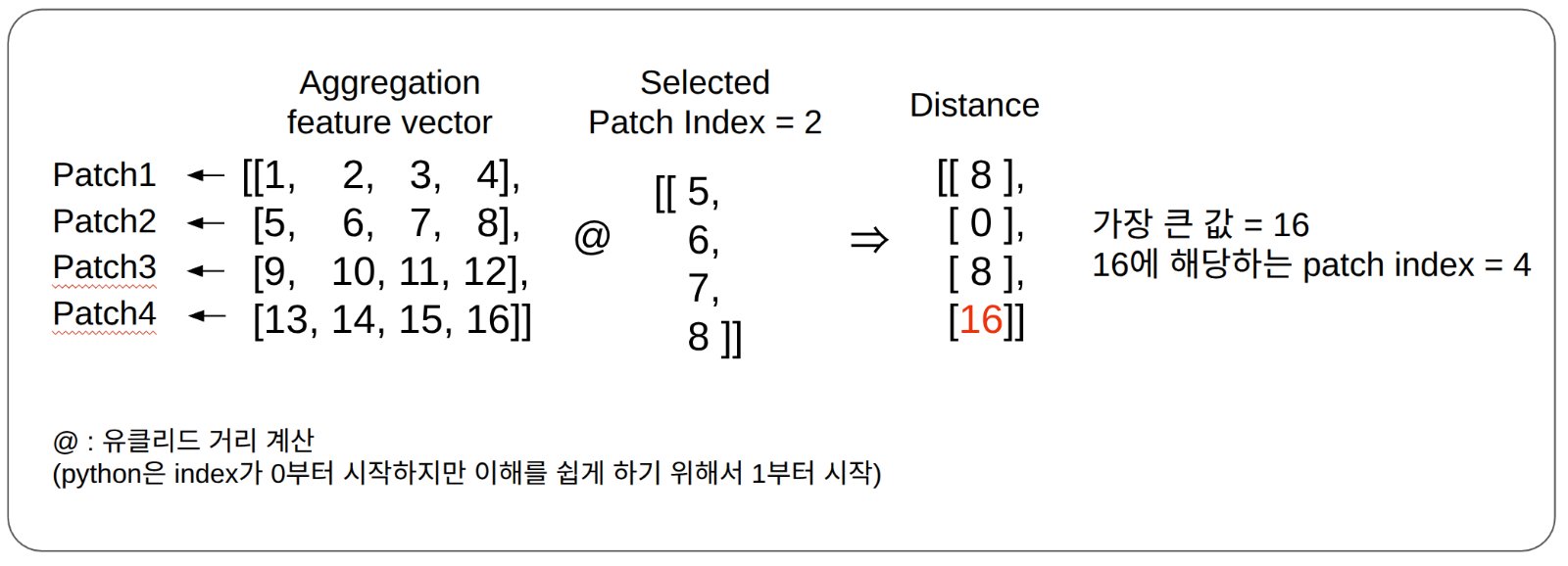
- 첫번째 index 2는 random으로 선택함, 다음 iteration에서는 distance가 16(빨간색)으로 가장 큰 4번째 patch를 비교
- 유클리드 거리는 유사성을 나타냄. 거리가 가까울수록 유사성이 높고 거리가 멀수록 유사성이 낮음
거리값이 가장 큰 16은 2번째 patch와 4번째 patch가 많이 다른 형태의 데이터라는 것을 의미
- 독특한 데이터일 가능성이 높음
- 특징이 두드러짐
- 수많은 patch에서 중심이 되는 core patch일 가능성이 높음
2. 두번째 iteration
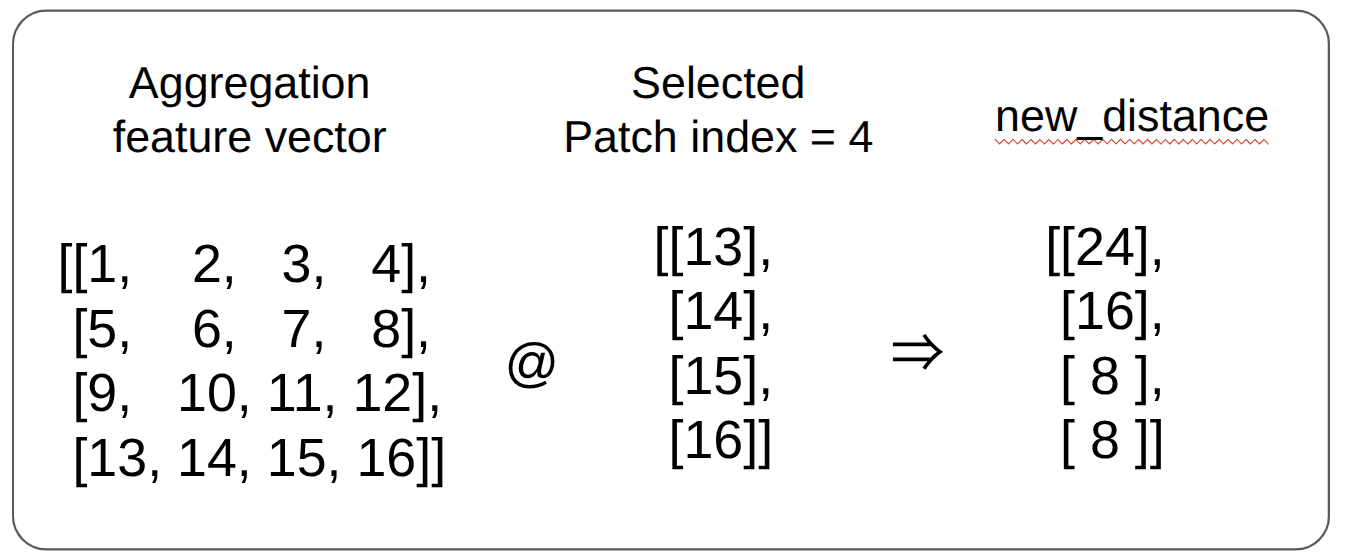
- 4번째 patch와 다른 patch와의 유클리드 거리 계산
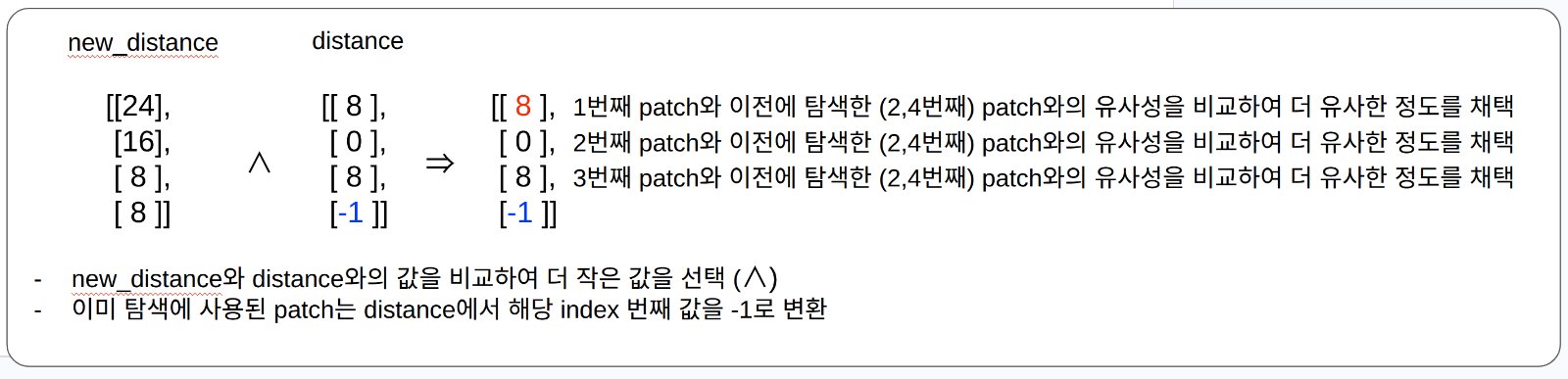
- 거리의 최소값을 선택하고 그중에서 가장 큰 거리 값(빨간색)을 가지는 1번째 patch를 선택
- 최소값을 선택했다는 것은 가장 유사한 patch를 선택했다는 의미이며 그중에서 최솟값 중에서 가장 큰 값을 선택했다는 것은 가장 유사한 값을 선택했음에도 불구하고 여전히 다른 patch들과 많이 다르다는 의미
- 유클리드 거리가 가장 큰 patch를 선택 = 가장 특이한 patch를 선택
- 배경과 같은 평범한 데이터가 아니라 제품의 독특한 특징을 메모리 뱅크에 담아야 하므로 특이한 patch를 메모리 뱅크에 저장해야 나중에 이상치 데이터와 비교했을 때 차이를 쉽게 구별 가능.
3. 최종 메모리 뱅크
Selected index에 해당하는 patch들만 메모리 뱅크에 저장함
selected_index = Coreset Subsample index = [2,4,1]
코드 보기
"""PatchCore의 greedy coreset selection 모듈."""
import argparse
import shutil
import tempfile
from pathlib import Path

import numpy as np
import torch


@torch.no_grad()
def greedy_coreset_indices(
    work: torch.Tensor,
    target_size: int,
    seed: int = 0,
    verbose: bool = True,
) -> torch.Tensor:
    """Greedy minimax facility location coreset 선택.

    Args:
        work: [N, d*] 선택 기준으로 쓸 feature 행렬 (JL 사영된 것 또는 원본)
        target_size: 선택할 coreset 크기 l
        seed: 시작점 재현용 시드
    Returns:
        [target_size] 선택된 인덱스 (LongTensor)
    """
    N = work.shape[0]
    device = work.device
    gen = torch.Generator(device="cpu").manual_seed(seed)

    # --- greedy 선택 ---
    # min_dists[i] = i번째 점에서 현재까지 선택된 coreset까지의 최소 거리 제곱.
    # 매 스텝 argmax(min_dists)를 추가하고, 새 점과의 거리로 min_dists를 갱신.
    # ||a-b||^2 = ||a||^2 - 2*a·b + ||b||^2 전개로 계산한다: torch.cdist는 매 스텝
    # [N, d*] 크기의 임시 버퍼를 새로 할당해 GPU에서 OOM을 유발하므로, 대신
    # 행렬-벡터 곱(GEMV)만 써서 O(N) 메모리로 거리를 구한다.
    norms_sq = (work * work).sum(dim=1)  # [N]

    def sq_dists_to(idx: int) -> torch.Tensor:
        # idx번째 점과 나머지 모든 점들이 얼마나 멀리 떨어져 있는지를 구하는 함수, 유클리안 거리, (a-b)^2 = a^2-2(a*b)+b^2 식에서 각 항을 미리 계산한 후에 수식에 대입
        cross = work @ work[idx]  # [N]
        return (norms_sq - 2.0 * cross + norms_sq[idx]).clamp_(min=0)

    start = int(torch.randint(N, (1,), generator=gen).item())
    selected = torch.empty(target_size, dtype=torch.long, device=device)
    selected[0] = start # patch index 값 random으로 선택

    min_dists = sq_dists_to(start) #start번째 patch와 자기자신을 포함한 다른 patch와의 유클리드 거리 계산

    for i in range(1, target_size):
        idx = int(torch.argmax(min_dists).item()) #전체 patch와 선택된 한개의 patch 중에서 가장 거리가 먼 patch index
        selected[i] = idx #다음 거리 계산 patch index
        new_dists = sq_dists_to(idx)
        torch.minimum(min_dists, new_dists, out=min_dists)
        min_dists[idx] = -1.0  # 이미 선택된 점은 다시 뽑히지 않도록

        if verbose and (i % max(1, target_size // 10) == 0):
            # coverage radius: 아직 커버되지 않은 점 중 가장 먼 거리 (Eq. 5의 max-min 항)
            print(f"  [{i}/{target_size}] coverage radius^2 = {min_dists.max().item():.4f}")

    return selected # 선택된 이전 patch들과 거리가 먼 순서대로 patch index 나열 [3,77,5,2,8] 첫번째는 random이므로 무시,


def scan_patch_files(input_dir: Path) -> tuple[list[Path], int, int]:
    """.npy 파일들의 헤더만 읽어 (전체 로드 없이) 총 patch 수 N과 차원 d를 파악."""
    npy_files = sorted(p for p in input_dir.iterdir() if p.suffix == ".npy")
    if not npy_files:
        raise FileNotFoundError(f"{input_dir}에 .npy 확장자 파일이 없습니다.")

    total = 0
    dim: int | None = None
    for f in npy_files:
        arr = np.load(f, mmap_mode="r")
        if arr.ndim == 4:
            B, C, H, W = arr.shape
            n = B * H * W #n : 1채널에서의 벡터 크기,batch 포함, 기본 batch가 1이므로 batch는 없는거나 다름없음
        elif arr.ndim == 2: # 필요없는 코드 인듯
            n, C = arr.shape
        else:
            raise ValueError(f"{f.name}: 지원하지 않는 shape {arr.shape} (2D 또는 4D[B,C,H,W]만 지원)")
        if dim is None:
            dim = C
        elif dim != C:
            raise ValueError(f"{f.name}: 차원 불일치 (기대 {dim}, 실제 {C})")
        total += n
    assert dim is not None
    return npy_files, total, dim
    #디렉토리에 있는 모든 npy파일 리스트, 디렉토리에 있는 모든 npy의 patch 개수(모든 npy파일에서의 row 개수), npy파일에서의 채널수

def stream_build_bank(
    npy_files: list[Path],
    total: int #npy_files의 총 patch 개수,
    dim: int #npy_files의 channel,
    bank_path: Path,
    proj_dim: int | None #해당 값으로 차원 축소,
    seed: int,
) -> tuple[np.memmap, torch.Tensor]:
    """파일을 하나씩 읽어 원본 차원 patch bank는 디스크 memmap에 채우고,
    JL 사영된 저차원 표현(work)은 RAM에 누적한다.

    한 시점에 RAM에 올라오는 원본 데이터는 파일 하나 분량뿐이므로,
    전체 patch 수가 많아도 메모리 사용량은 O(파일 하나 크기 + N x proj_dim)로 유지된다.
    """
    bank = np.lib.format.open_memmap(bank_path, mode="w+", dtype=np.float32, shape=(total, dim))

    use_proj = proj_dim is not None and proj_dim < dim
    psi: torch.Tensor
    work: torch.Tensor
    if use_proj and proj_dim is not None:
        gen = torch.Generator(device="cpu").manual_seed(seed)
        psi = torch.randn(dim, proj_dim, generator=gen) / np.sqrt(proj_dim)
        work = torch.empty((total, proj_dim), dtype=torch.float32)

    offset = 0
    for f in npy_files:
        arr = np.load(f)
        if arr.ndim == 4:
            B, C, H, W = arr.shape
            patches = arr.transpose(0, 2, 3, 1).reshape(-1, C)
        else:
            patches = arr
        n = patches.shape[0] #B*H*W
        bank[offset:offset + n] = patches
        if use_proj:
            work[offset:offset + n] = torch.from_numpy(patches).float() @ psi
        print(f"  {f.name}: {arr.shape} -> {n} patches ({offset + n}/{total})")
        offset += n

    bank.flush()
    if not use_proj:
        # 원본 차원을 그대로 선택 공간으로 사용 (memmap 기반, page cache로 관리되어
        # concatenate 방식보다 안전하지만 여전히 RAM 부담이 클 수 있음)
        work = torch.from_numpy(bank)
    return bank, work #work : patch 개수는 그대로, 벡터 크기만 줄어듬, (16,32) -> (16,8)


if __name__ == "__main__":
    input_dir = Path(args.input)
    npy_files, N, d = scan_patch_files(input_dir)
    target = max(1, int(N * args.percentage)) # 최종 patch 개수
    proj = args.proj_dim if args.proj_dim and args.proj_dim > 0 else None
    print(f"입력: 총 {N} patches x {d} dims -> coreset {target}개 선택 "
          f"({args.percentage:.1%}), proj_dim={proj or '없음'}")
    if proj is None:
        print("  [경고] proj-dim 생략: 선택 단계에서 원본 차원 전체를 사용하므로 메모리 부담이 큽니다.")

    output_dir = Path(args.output) if args.output else input_dir.parent / "coreset"
    output_dir.mkdir(parents=True, exist_ok=True)

    tmp_dir = Path(tempfile.mkdtemp(dir=output_dir))
    bank_path = tmp_dir / "patch_bank.npy"
    try:
        print(f"patch bank를 디스크에 스트리밍 저장 중: {bank_path}")
        bank, work = stream_build_bank(npy_files, N, d, bank_path, proj, args.seed)

        if args.device == "auto":
            device = "cuda" if torch.cuda.is_available() else "cpu"
        else:
            device = args.device
        print(f"선택 연산 장치: {device}")
        work = work.to(device)

        indices = greedy_coreset_indices(work, target, seed=args.seed)
        idx_np = indices.cpu().numpy()

        coreset = np.array(bank[idx_np])  # 원본 차원 feature를 memmap에서 필요한 행만 읽어 복사
        del bank, work
    finally:
        shutil.rmtree(tmp_dir, ignore_errors=True)

    coreset_path = output_dir / "MB.npy"
    indices_path = output_dir / "MB_indices.npy"
    np.save(coreset_path, coreset)
    np.save(indices_path, idx_np)
    print(f"저장 완료: {coreset_path}  shape={coreset.shape}")
    print(f"인덱스 저장 완료: {indices_path}")
Testing
1. 테스트 이미지를 Training의 1~2번 과정을 똑같이 진행합니다.
2. 테스트 이미지의 특징과 메모리 뱅크를 이용하여 Anomaly Score(AS)를 계산합니다.
- 패치 중에서 가장 큰 AS를 해당 이미지의 대표 AS로 간주합니다.
- Anomaly Score 계산식
- 테스트 patch와 메모리 뱅크와의 유클리드거리 값을 단순히 anomaly score로 사용하는 것이 아니라 softmax를 기반으로 가중치를 계산하여 최종 anomaly score로 사용
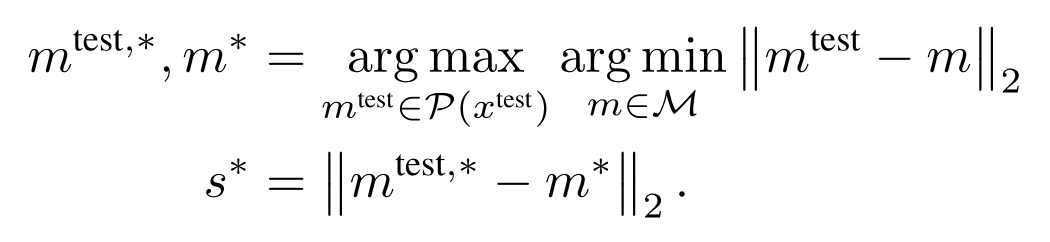

<계산 로직>
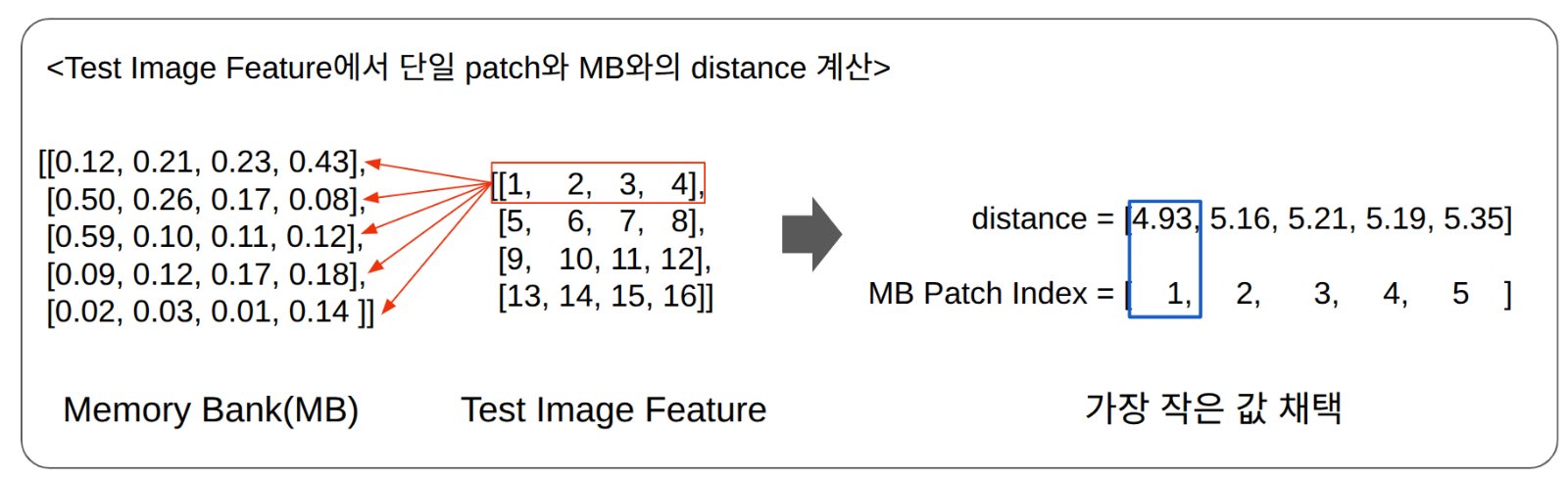
- 전체 테스트 이미지 patch 한개와 메모리 뱅크에 있는 모든 patch 사이의 유클리드 거리 계산 후 가장 작은 값을 채택
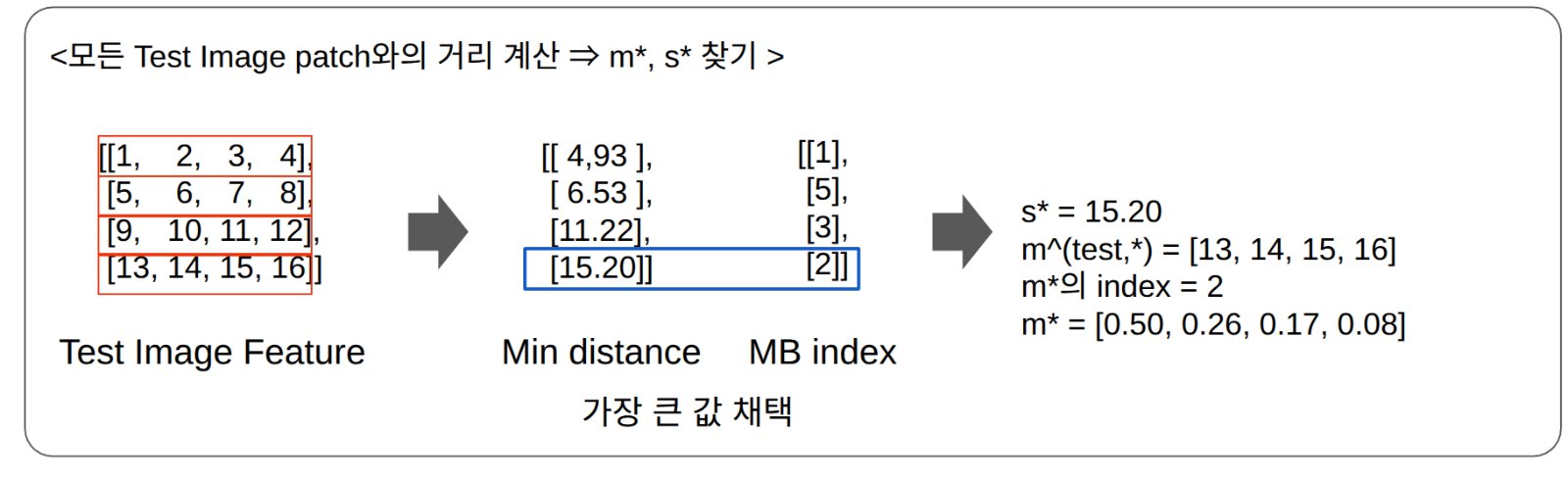
- 모든 테스트 patch에 대해서 최소 거리를 계산 후, 가장 큰 값을 가지는 메모리 뱅크의 patch를 찾음 = m*
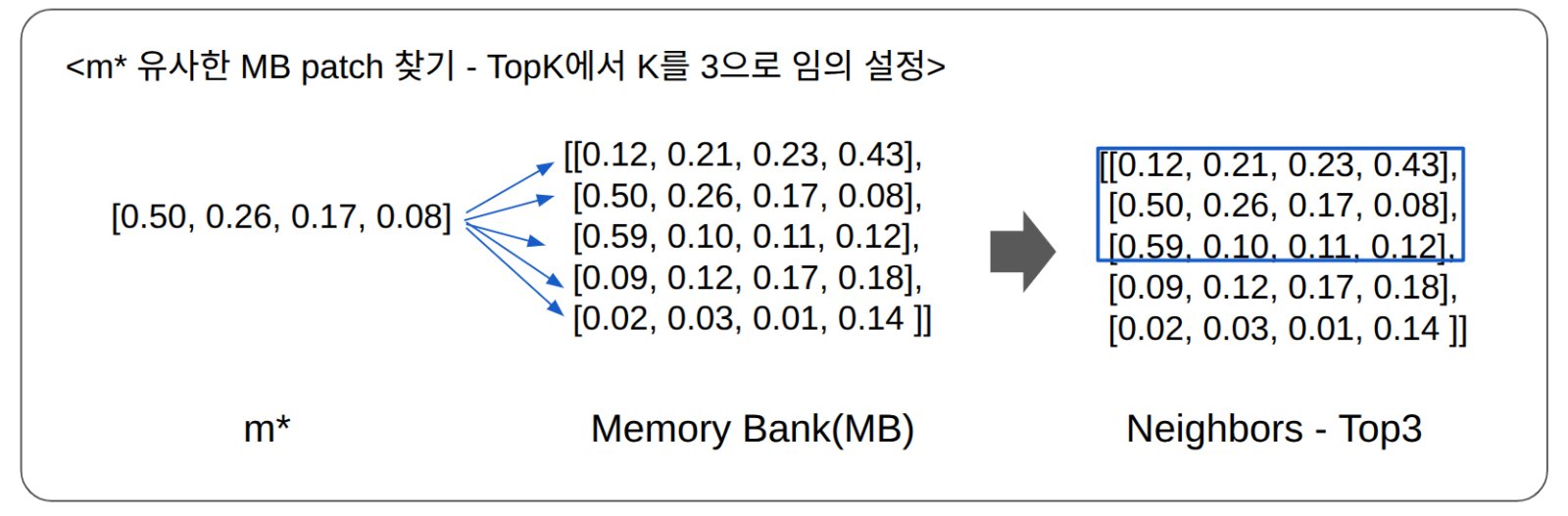
- anomaly score에 사용될 가중치를 계산하기(softmax)
- m*와 메모리 뱅크 사이의 유클리드 거리 계산을 수행 후 거리값이 작은 상위 k를 이웃 patch로 설정 = Nb(m*)
- 가중치 계산
- 이웃 patch와 테스트 patch 와의 유클리드 거리 계산 후 해당 값의 합에 지수를 취한 값을 가중치의 분모로 사용
- 분자는 테스트 patch와 메모리 뱅크 사이의 가장 작은 유클리드 거리 값에 지수를 취함
- 최종 가중치 계산 : 1-(b-3/b-4)
- softmax를 사용해서 이웃 patch와 m* 와의 차이를 가중치로 주기 위함
- 가중치가 큼
- m*가 이웃들과 유사한 경우
- test patch가 확실히 메모리 뱅크와 차이가 있다는 의미
- 가중치를 크게 함으로써 anomalous를 확실하게 표현
- 가중치가 작음
- m*가 이웃들과 다른 경우
- test patch가 우연히 메모리 뱅크에 저장되지 않은 영역과 유사해서 발생한 경우 일 수도 있음 → coverage 부족
- coverage 부족으로 인한 노이즈인지 실제로 차이가 적은 것인지 확실히 알 수 없으므로 가중치를 낮게 설정 = false positive를 줄임
3. 모든 patch에 대해서 AS가 계산이 완료되면 원본 이미지 크기로 복원합니다.
- interpolation을 사용하여 anomaly score map을 원본 이미지 크기로 복원합니다.
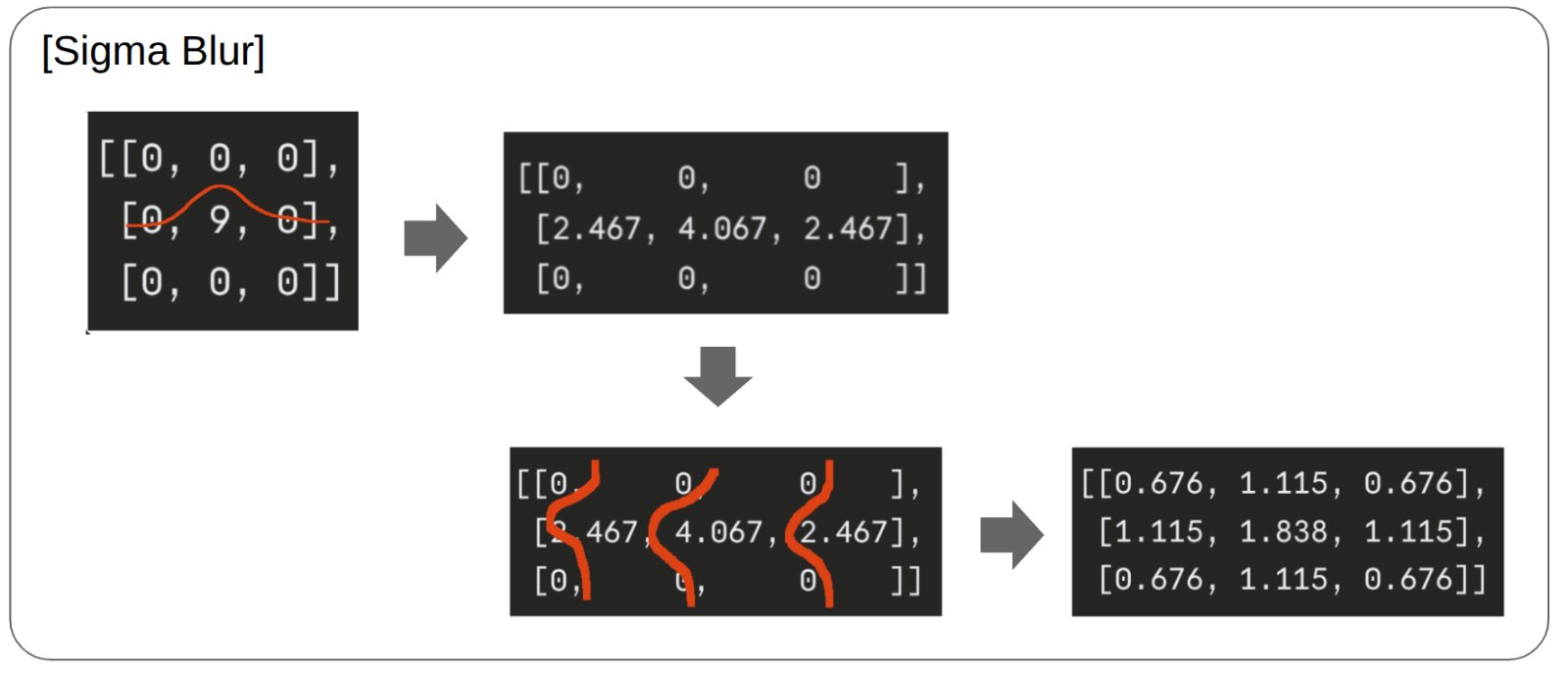
- Sigma blur를 사용하여 smooth하게 합니다.
4. 양품/불량 판단하기
- 양품 데이터들의 AS를 계산하여 양품 AS 분포를 구합니다. 여기서 AS는 patch 중에서 anomaly score가 가장 큰 값입니다.
- 테스트 이미지의 AS 점수가 양품 AS 분포에서 95% 이상에 속하면 이상치로 판단합니다.
5. 히트맵 그리기
- 양품 데이터의 AS 분포에서 하위 5%와 상위 95% 이상을 버리고 나머지 데이터에서 최솟값과 최댓값을 기준치로 설정합니다.
- 3번에서 복원한 이미지 feature map을 이전에 계산한 양품 AS의 최솟값과 최댓값으로 정규화를 수행합니다.
- 정규화를 하는 이유는 절댓값으로 시각화를 진행시, 아주 작은 AS에도 이상치처럼 보이기 때문에 양품의 AS를 기준으로 정규화를 수행하여 양품 범주에서 벗어난 부분만을 확대해서 볼 수 있습니다.
코드 보기
"""PatchCore anomaly scoring (feature extraction 이후 단계만).

입력:
    test_feat   : (P, C) 또는 (B, P, C)   -- 추출 완료된 test patch feature
                  P = Hf * Wf (예: 72*72 = 5184), C = feature 차원 (예: 1024)
    memory_bank : (M, C)                  -- 구축 완료된 coreset memory bank

출력:
    patch_scores : (B, Hf, Wf)  patch별 anomaly score (= 1-NN 거리)
    image_scores : (B,)         softmax re-weighting 적용된 이미지 score (Eq. 7)
    anomaly_map  : (B, H, W)    원본 해상도로 upsample + Gaussian blur

"""

import argparse
import json
from pathlib import Path

import matplotlib
matplotlib.use("Agg")
import matplotlib.pyplot as plt
import numpy as np
import torch
import torch.nn.functional as F
from PIL import Image

DEVICE = torch.device("cuda" if torch.cuda.is_available() else "cpu")

SCRIPT_DIR = Path(__file__).resolve().parent
PROJECT_DIR = SCRIPT_DIR.parent

DEFAULT_MEMORY_BANK = PROJECT_DIR / "Data" / "memory_bank" / "masked_img_view1" / "MB.npy"
DEFAULT_TEST_IMAGE = (
    PROJECT_DIR / "Data" / "features" / "test" / "bad" / "masked_img"
    / "masked_rubbish_bin_01_bad_01_0.png"
)
DEFAULT_OUTPUT_DIR = PROJECT_DIR / "Data" / "features" / "test" / "bad" / "output"
DEFAULT_HEATMAP_RANGE = Path("/mnt/data/github/Manufacutring_Inspection/data/memory_bank/heatmap_range.json")
# memory bank와 grid가 항상 일치하는 최신 feature 저장소 (pages/2_Analysis.py가 채움).
# test_image의 feature는 항상 여기서 찾는다 (다른 img_size로 추출된 stale feature 혼입 방지).
APP_AGG_DIR = Path("/mnt/data/github/Manufacutring_Inspection/data/features/app/agg")


class PatchCoreScorer:
    def __init__(self, memory_bank: torch.Tensor, k_nn: int = 3,
                 blur_sigma: float = 4.0, chunk: int = 2048):
        """
        Args:
            memory_bank: (M, C) coreset memory bank
            k_nn: re-weighting에 사용할 bank 내 neighbor 수 (논문의 b)
            blur_sigma: anomaly map Gaussian smoothing sigma
            chunk: cdist 메모리 절약용 chunk 크기
        """
        self.bank = memory_bank.to(DEVICE)          # (M, C)
        self.k_nn = min(k_nn, self.bank.shape[0])
        self.blur_sigma = blur_sigma
        self.chunk = chunk

    # ------------------------------------------------------------------
    # Step 1. patch별 1-NN 거리 (= patch anomaly score)
    # ------------------------------------------------------------------
    @torch.no_grad()
    def _nn_distance(self, flat: torch.Tensor):
        """
        flat: (P_total, C)
        Returns:
            dmin (P_total,)  각 patch에서 bank까지의 최소 거리
            imin (P_total,)  그 최근접 bank 점의 index (re-weighting에 필요)
        """
        dists, idxs = [], []
        for i in range(0, flat.shape[0], self.chunk):
            d = torch.cdist(flat[i:i + self.chunk], self.bank)   # (chunk, M)
            dmin, imin = d.min(dim=1)
            dists.append(dmin)
            idxs.append(imin)

        #dists = [tensor([0.0000, 3.6056, 0.0000]),
        #         tensor([1.2345, 2.3456, 0.5000])]

        return torch.cat(dists), torch.cat(idxs)

    # ------------------------------------------------------------------
    # Step 2. 이미지 score: softmax re-weighting (논문 Eq. 7)
    # ------------------------------------------------------------------
    @torch.no_grad()
    def _image_score(self, feat_b: torch.Tensor,
                     patch_dist_b: torch.Tensor,
                     nn_idx_b: torch.Tensor) -> torch.Tensor:
        """
        feat_b       : (P, C)  한 이미지의 patch feature
        patch_dist_b : (P,)    patch별 1-NN 거리
        nn_idx_b     : (P,)    patch별 최근접 bank index

        s = (1 - exp(s*) / sum_{m in N_b(m*)} exp(d(x*, m))) * s*

        직관: 가장 anomalous한 patch x*의 최근접 bank 점 m*가
        bank 내에서 '외딴 점'이면(이웃이 멀면) 확신을 낮추고,
        '밀집 영역의 점'이면 s*를 거의 그대로 사용.
        => 하나의 이미지에 대한 anomaly score 스칼라 값
        """
        # (1) 가장 anomalous한 test patch x* 선택
        p_star = torch.argmax(patch_dist_b)
        s_star = patch_dist_b[p_star]                # 최대 patch 거리
        x_star = feat_b[p_star:p_star + 1]           # (1, C)
        m_star = nn_idx_b[p_star]                    # x*의 최근접 bank 점

        # (2) m*의 bank 내 b-nearest neighbors N_b(m*)
        d_bank = torch.cdist(self.bank[m_star:m_star + 1], self.bank).squeeze(0)
        nb_idx = torch.topk(d_bank, k=self.k_nn, largest=False).indices

        # (3) x*에서 그 neighbor들까지의 거리
        d_nb = torch.cdist(x_star, self.bank[nb_idx]).squeeze(0) #(k_nn,)

        # 수치 안정화: 최대값 빼고 exp (오버플로 방지, 비율은 동일)
        m = torch.maximum(s_star, d_nb.max())
        w = 1 - torch.exp(s_star - m) / torch.exp(d_nb - m).sum()
        return w * s_star

    # ------------------------------------------------------------------
    # Step 3. anomaly map: 72x72 -> 원본 해상도 + Gaussian blur
    # ------------------------------------------------------------------
    @torch.no_grad()
    def _make_anomaly_map(self, patch_scores: torch.Tensor,
                          out_size: tuple[int, int]) -> torch.Tensor:
        amap = patch_scores.unsqueeze(1)        # (B,1,Hf,Wf)
        amap = F.interpolate(amap, size=out_size, mode="bilinear",
                             align_corners=False).squeeze(1)  # (B,H,W)

        sigma = self.blur_sigma
        ks = int(4 * sigma + 1) | 1
        coords = torch.arange(ks, device=amap.device) - ks // 2
        g = torch.exp(-(coords ** 2) / (2 * sigma ** 2))
        g = (g / g.sum()).view(1, 1, -1)
        x = amap.unsqueeze(1)
        x = F.conv2d(x, g.unsqueeze(2), padding=(0, ks // 2))
        x = F.conv2d(x, g.unsqueeze(3), padding=(ks // 2, 0))
        return x.squeeze(1)

    # ------------------------------------------------------------------
    # 전체 scoring 파이프라인
    # ------------------------------------------------------------------
    @torch.no_grad()
    def score(self, test_feat: torch.Tensor, grid: tuple[int, int],
              out_size: tuple[int, int] | None = None,
              fg_mask: torch.Tensor | None = None) -> dict:
        """
        Args:
            test_feat: (P, C) 단일 이미지 또는 (B, P, C) 배치
            grid: (Hf, Wf), 예: (72, 72)
            out_size: anomaly map 출력 해상도 (None이면 map 생략)
            fg_mask: (B, Hf, Wf) bool, True=foreground.
                     지정 시 background patch score를 0으로 마스킹
                     (image score의 argmax에서도 제외됨)
        Returns:
            dict(patch_scores, image_scores[, anomaly_map])
        """
        if test_feat.dim() == 2:
            test_feat = test_feat.unsqueeze(0)       # (1, P, C)
        test_feat = test_feat.to(DEVICE)
        B, P, C = test_feat.shape
        Hf, Wf = grid
        assert P == Hf * Wf, f"P={P} != Hf*Wf={Hf * Wf}"

        # ---- Step 1: patch scores ----
        flat = test_feat.reshape(-1, C)              # (1(B)*P, C)
        dmin, imin = self._nn_distance(flat)
        patch_dist = dmin.reshape(B, P)              # (1(B), P)
        nn_idx = imin.reshape(B, P)

        # ---- foreground masking (선택) ----
        if fg_mask is not None:
            mask_flat = fg_mask.reshape(B, P).to(DEVICE)
            patch_dist = patch_dist * mask_flat      # bg patch -> 0

        # ---- Step 2: image scores (re-weighting) ----
        image_scores = torch.empty(B, device=DEVICE)
        for b in range(B):
            image_scores[b] = self._image_score(test_feat[b], patch_dist[b], nn_idx[b])

        out = {
            "patch_scores": patch_dist.reshape(B, Hf, Wf).cpu(),
            "image_scores": image_scores.cpu(),
        }

        # ---- Step 3: anomaly map (선택) ----
        if out_size is not None:
            out["anomaly_map"] = self._make_anomaly_map(
                patch_dist.reshape(B, Hf, Wf), out_size).cpu()
        return out


# ----------------------------------------------------------------------------
# 입출력 helper
# ----------------------------------------------------------------------------
def load_memory_bank(path: Path) -> torch.Tensor:
    """(M, C) memory bank npy -> tensor"""
    bank = np.load(path)
    return torch.from_numpy(bank).float()


def load_test_feature(path: Path) -> tuple[torch.Tensor, tuple[int, int]]:
    """(1, C, Hf, Wf) test feature npy -> (1, Hf*Wf, C) tensor, (Hf, Wf)"""
    feat = np.load(path)
    if feat.ndim != 4 or feat.shape[0] != 1:
        raise ValueError(f"예상하지 못한 shape: {feat.shape}  (기대: (1, C, Hf, Wf))")
    _, c, hf, wf = feat.shape
    flat = feat[0].transpose(1, 2, 0).reshape(1, hf * wf, c)   # (1, P, C)
    return torch.from_numpy(np.ascontiguousarray(flat)).float(), (hf, wf)


def foreground_mask_from_image(image: Image.Image, threshold: int = 10) -> np.ndarray:
    """masked_img(배경=검정)에서 foreground mask 추출.

    Returns:
        (H, W) bool array, True=foreground (밝기 > threshold)
    """
    gray = np.asarray(image.convert("L"), dtype=np.uint8)
    return gray > threshold #든 픽셀마다 하나하나 조건 비교(Element-wise comparison)를 수행하여 True, False로 모든 배열 표시


def calibrate_score_range(
    scorer: "PatchCoreScorer",
    normal_feature_paths: list[Path],
    sample_n: int = 30,
    vmin_percentile: float = 0.5,
    vmax_percentile: float = 99.5,
    vmax_margin: float = 1.5,
    seed: int = 0,
) -> tuple[float, float]:
    """정상 이미지들의 patch score 분포로 히트맵에 쓸 고정 (vmin, vmax)를 계산.
    """
    if not normal_feature_paths:
        raise ValueError("calibrate_score_range: normal_feature_paths가 비어 있습니다.")

    rng = np.random.default_rng(seed)
    paths = list(normal_feature_paths)
    if len(paths) > sample_n:
        idx = rng.choice(len(paths), size=sample_n, replace=False)
        paths = [paths[i] for i in idx]

    all_scores = []
    for p in paths:
        test_feat, _ = load_test_feature(p)
        flat = test_feat.reshape(-1, test_feat.shape[-1]).to(DEVICE)
        dmin, _ = scorer._nn_distance(flat)
        all_scores.append(dmin.cpu().numpy())

    scores = np.concatenate(all_scores)
    vmin = float(np.percentile(scores, vmin_percentile))
    vmax = float(np.percentile(scores, vmax_percentile)) * vmax_margin
    print(f"[캘리브레이션] 정상 이미지 {len(paths)}장, patch {scores.size}개 "
          f"-> vmin={vmin:.4f} (p{vmin_percentile}), "
          f"vmax={vmax:.4f} (p{vmax_percentile} x {vmax_margin})")
    return vmin, vmax


def calibrate_image_score_threshold(
    scorer: "PatchCoreScorer",
    normal_pairs: list[tuple[Path, Path]],
    sample_n: int = 30,
    percentile: float = 99.5,
    margin: float = 1.0,
    seed: int = 0,
) -> float:
    """정상 이미지들의 image_score 분포로 Normal/Abnormal 판정 threshold를 계산.
    """
    if not normal_pairs:
        raise ValueError("calibrate_image_score_threshold: normal_pairs가 비어 있습니다.")

    rng = np.random.default_rng(seed)
    pairs = list(normal_pairs)
    if len(pairs) > sample_n:
        idx = rng.choice(len(pairs), size=sample_n, replace=False)
        pairs = [pairs[i] for i in idx]

    image_scores = []
    for feature_path, image_path in pairs:
        test_feat, grid = load_test_feature(feature_path)
        image = Image.open(image_path)
        fg_mask_full = foreground_mask_from_image(image)
        fg_mask_grid = F.adaptive_max_pool2d(
            torch.from_numpy(fg_mask_full).float()[None, None], output_size=grid
        ).squeeze(1).bool()
        result = scorer.score(test_feat, grid=grid, fg_mask=fg_mask_grid)
        image_scores.append(float(result["image_scores"][0]))

    scores = np.array(image_scores)
    threshold = float(np.percentile(scores, percentile)) * margin
    print(f"[캘리브레이션] 정상 이미지 {len(pairs)}장 image_score 분포 "
          f"-> threshold={threshold:.4f} (p{percentile} x {margin})")
    return threshold


def save_result(image_path: Path, anomaly_map: np.ndarray, image_score: float,
                 out_dir: Path, stem: str, fg_mask: np.ndarray | None = None,
                 vmin: float | None = None, vmax: float | None = None) -> None:
    """anomaly map 히트맵(원본 사진 없이 raw score 그대로)과 raw anomaly map npy를 out_dir에 저장.
    """
    out_dir.mkdir(parents=True, exist_ok=True)

    image = Image.open(image_path).convert("RGB")

    npy_path = out_dir / f"{stem}_anomaly_map.npy"
    np.save(npy_path, anomaly_map)

    display_map = np.ma.masked_array(anomaly_map, mask=~fg_mask) if fg_mask is not None else anomaly_map

    fig, ax = plt.subplots(figsize=(image.width / 100, image.height / 100), dpi=100)
    ax.imshow(display_map, cmap="jet", vmin=vmin, vmax=vmax)
    ax.set_title(f"image_score={image_score:.4f}")
    ax.axis("off")
    fig.tight_layout()

    png_path = out_dir / f"{stem}_anomaly_map.png"
    fig.savefig(png_path, dpi=100)
    plt.close(fig)

    print(f"[저장] {npy_path}")
    print(f"[저장] {png_path}")


def parse_args() -> argparse.Namespace:
    parser = argparse.ArgumentParser(
        description="memory bank + test feature -> PatchCore anomaly score/map 계산 및 저장",
        formatter_class=argparse.RawTextHelpFormatter,
    )
    parser.add_argument("--memory_bank", type=str, default=str(DEFAULT_MEMORY_BANK),
                        help="memory bank (M, C) npy 경로")
    parser.add_argument("--test_image", type=str, default=str(DEFAULT_TEST_IMAGE),
                        help="test sample 원본 이미지 경로. feature는 "
                             f"{APP_AGG_DIR}/{{test_image의 stem}}_local.npy 에서 자동으로 찾는다.")
    parser.add_argument("--output_dir", type=str, default=str(DEFAULT_OUTPUT_DIR),
                        help="결과 저장 상위 디렉토리 (test feature 파일명으로 하위 폴더 생성)")
    parser.add_argument("--k_nn", type=int, default=3, help="image score re-weighting neighbor 수")
    parser.add_argument("--blur_sigma", type=float, default=4.0, help="anomaly map Gaussian blur sigma")
    return parser.parse_args()


def main() -> None:
    args = parse_args()

    memory_bank_path = Path(args.memory_bank)
    test_image_path = Path(args.test_image)
    output_dir = Path(args.output_dir)

    # ---- test feature 경로: data/features/app/agg에 미리 추출된 feature만 사용 ----
    # (다른 img_size로 추출된 stale feature를 잘못 넘겨서 memory bank와 grid가
    #  어긋나는 문제를 원천 차단하기 위해, 경로를 test_image로부터 항상 여기서 계산한다)
    test_feature_path = APP_AGG_DIR / f"{test_image_path.stem}_local.npy"
    if not test_feature_path.exists():
        raise FileNotFoundError(
            f"app/agg에 feature가 없습니다: {test_feature_path}\n"
            f"먼저 feature extraction 파이프라인으로 {APP_AGG_DIR}에 해당 이미지의 "
            f"feature를 생성하세요."
        )
    print(f"[feature] {test_feature_path}")

    # ---- 1. bank + test feature 로드 ----
    bank = load_memory_bank(memory_bank_path)
    print(f"memory bank : {tuple(bank.shape)}")

    test_feat, grid = load_test_feature(test_feature_path)
    print(f"test feature: {tuple(test_feat.shape)}  grid={grid}")

    image = Image.open(test_image_path)
    out_size = (image.height, image.width)

    # ---- fg_mask: masked_img(배경=검정)에서 foreground 영역 추출 ----
    fg_mask_full = foreground_mask_from_image(image)    # (H, W) bool
    fg_mask_grid = F.adaptive_max_pool2d(
        torch.from_numpy(fg_mask_full).float()[None, None], output_size=grid
    ).squeeze(1).bool()                 # (1, Hf, Wf)
    # fg_mask_grid
    # tensor([[[False, False, False],
    #          [False, True,  False],
    #          [False, True, False]]])


    # ---- 2. scoring ----
    scorer = PatchCoreScorer(bank, k_nn=args.k_nn, blur_sigma=args.blur_sigma)
    result = scorer.score(test_feat, grid=grid, out_size=out_size, fg_mask=fg_mask_grid)

    image_score = float(result["image_scores"][0])
    anomaly_map = result["anomaly_map"][0].numpy()
    print(f"image_score : {image_score:.4f}")
    print(f"anomaly_map : {anomaly_map.shape}")

    # ---- 2b. 히트맵 색 스케일(vmin/vmax): find_heapmap_range.py가 미리 계산해둔 json에서 읽음 ----
    with open(DEFAULT_HEATMAP_RANGE) as f:
        heatmap_range = json.load(f)
    vmin, vmax = heatmap_range["vmin"], heatmap_range["vmax"]
    print(f"heatmap range: vmin={vmin:.4f}, vmax={vmax:.4f}  (출처: {DEFAULT_HEATMAP_RANGE})")

    # ---- 3. 저장: output_dir/{test feature 파일명}/ 에 img + feature map npy ----
    stem = test_feature_path.stem
    save_result(test_image_path, anomaly_map, image_score, output_dir / stem, stem,
                fg_mask=fg_mask_full, vmin=vmin, vmax=vmax)


if __name__ == "__main__":
    main()
코드 보기
"""Anomaly 판단을 위한 threshold 계산 스크립트
memory bank + 정상 이미지 feature들로
  1) anomaly heatmap 색 스케일(vmin/vmax)
  2) Normal/Abnormal 판정 threshold (image_score 기준)
를 모두 percentile 방식으로 계산해 json으로 저장하는 스크립트.

anomaly_score.py의 calibrate_score_range()(patch score용)와
calibrate_image_score_threshold()(image_score용)를 그대로 재사용한다.
여기서 계산한 값들을 pages/2_Analysis.py가 그대로 읽어서 쓰므로, 하드코딩된
threshold 없이 memory bank가 바뀔 때마다 다시 계산해서 갱신하면 된다.
"""

import argparse
import glob
import json
from pathlib import Path

import pandas as pd

from anomaly_score import (
    PatchCoreScorer,
    calibrate_image_score_threshold,
    calibrate_score_range,
    load_memory_bank,
)


def _resolve_normal_pairs(calibrate_glob: str, csv_path: str, label: str) -> list[tuple[Path, Path]]:
    """calibrate_glob의 feature npy들과 csv의 원본 이미지 경로를 파일명으로 매칭."""
    df = pd.read_csv(csv_path)
    normal_rows = df[df["labels"] == label]
    stem_to_image = {Path(p).stem: Path(p) for p in normal_rows["data_path"]}

    pairs: list[tuple[Path, Path]] = []
    for feature_path in sorted(Path(p) for p in glob.glob(calibrate_glob)):
        image_stem = feature_path.stem.removesuffix("_local")
        image_path = stem_to_image.get(image_stem)
        if image_path is not None and image_path.exists():
            pairs.append((feature_path, image_path))
    return pairs


def main() -> None:
    args = parse_args()

    bank = load_memory_bank(Path(args.memory_bank))
    print(f"memory bank : {tuple(bank.shape)}")

    normal_paths = sorted(Path(p) for p in glob.glob(args.calibrate_glob))
    if not normal_paths:
        raise FileNotFoundError(f"--calibrate_glob에 해당하는 파일이 없습니다: {args.calibrate_glob}")

    scorer = PatchCoreScorer(bank, k_nn=args.k_nn)
    vmin, vmax = calibrate_score_range(
        scorer, normal_paths,
        sample_n=args.calibrate_sample_n,
        vmin_percentile=args.vmin_percentile,
        vmax_percentile=args.vmax_percentile,
        vmax_margin=args.vmax_margin,
        seed=args.seed,
    )

    result = {"vmin": vmin, "vmax": vmax}

    if args.calibrate_csv:
        normal_pairs = _resolve_normal_pairs(args.calibrate_glob, args.calibrate_csv, args.calibrate_label)
        if not normal_pairs:
            raise FileNotFoundError(
                f"--calibrate_csv({args.calibrate_csv})에서 --calibrate_glob과 매칭되는 "
                f"'{args.calibrate_label}' 이미지를 찾지 못했습니다."
            )
        anomaly_threshold = calibrate_image_score_threshold(
            scorer, normal_pairs,
            sample_n=args.calibrate_sample_n,
            percentile=args.threshold_percentile,
            margin=args.threshold_margin,
            seed=args.seed,
        )
        result["anomaly_threshold"] = anomaly_threshold
    else:
        print("[건너뜀] --calibrate_csv 미지정 -> anomaly_threshold 계산 생략")

    output_path = Path(args.output)
    output_path.parent.mkdir(parents=True, exist_ok=True)
    with open(output_path, "w") as f:
        json.dump(result, f, indent=2)

    print(f"[저장] {output_path}  {result}")


if __name__ == "__main__":
    main()
Result
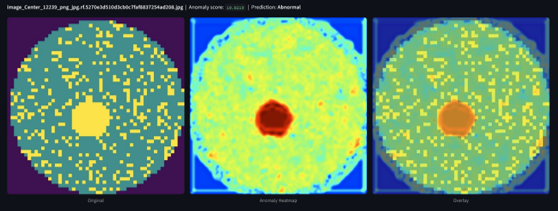
- 반도체 웨이퍼 데이터셋
Reference
[코드] : https://github.com/amazon-science/patchcore-inspection
[0] Towards total recall in industrial anomaly detection (https://arxiv.org/pdf/2106.08265)
[1] Roth, Karsten, et al. "Towards total recall in industrial anomaly detection." 2022 IEEE/CVF Conference on Computer Vision and Pattern Recognition (CVPR). IEEE, 2022.
[2] Chen, Qiyu, et al. "A unified anomaly synthesis strategy with gradient ascent for industrial anomaly detection and localization." European Conference on Computer Vision. Cham: Springer Nature Switzerland, 2024.
 GitHub
 LinkedIn